
サイトカイン

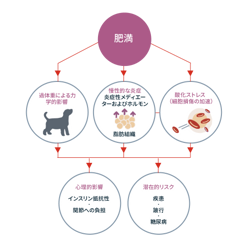
肥満は、体内に過剰な量の脂肪組織が蓄積している状態として定義されます。1
脂肪組織は、余分なエネルギーを蓄えるだけのものではなく、活発な内分泌器官でもあります。
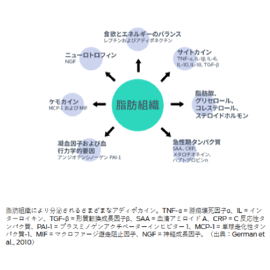
含脂肪細胞(脂肪細胞)は、さまざまなホルモン、サイトカイン、およびその他のタンパク因子(アディポカインと総称)を分泌し、体内の他の部分に生物学的な影響を与えています。
肥満が 慢性的な軽度の炎症を起こし、2 ペットが変形性関節症や糖尿病などの疾患を生じやすい状態と関連していることが示されています。

肥満と疾患を関連づける科学
脂肪組織は 100 種類以上のアディポカインを産生し、食欲調節から血圧に至るまで、全身に影響を与えます。これには、腫瘍壊死因子α(TNF-α)、インターロイキン 6、および C 反応性タンパク質などの炎症誘発性サイトカインが含まれます。3
アディポカインの分泌は肥満で変化が生じます。肥満に関するヒトの研究では、炎症性サイトカインの血中濃度が全身的に上昇しました。4 同様に、Purina やその他の機関において行われた研究において、肥満の犬猫を痩せた動物と比べた場合、炎症性アディポカインの濃度が上昇することが示されました。5-10


脂肪組織(より具体的には白色脂肪組織)は、これらの炎症性化合物の供給源であるため、炎症性アディポカイン濃度の上昇は、肥満と多くの体重に関連する疾患に関連していると考えられます。3,11
例えば、肥満におけるインスリン抵抗性は、インスリン受容体の活性化を阻害するサイトカインである TNF-α の濃度上昇と関連性があります。12-15
また、肥満がフリーラジカルの産生を高め、酸化ストレスの増大につながることも研究で示されています。酸化ストレスが組織損傷の一因となり、さまざまな疾患を発症させる働きをする可能性があります。16,17
こらの有害作用の多くは、減量することにより軽減または回復することができます。5,7,13, 18-20
覚えておくべき重要な点
- 脂肪組織は活発な内分泌器官であり、ホルモン、サイトカイン、およびその他のタンパク因子(アディポカインと総称)を分泌し、全身に生物学的な影響を与えています。
- インスリン抵抗性、炎症、酸化ストレス、およびその他の生物学的機能に影響を及ぼすアディポカインは、肥満で変化が生じます。
- 減量は、炎症のバイオマーカーであるアディポカインの減少と関連しています。
健康体重を管理する分野を探索する




詳しく知る
- Kopelman, P. G. (2000). Obesity as a medical problem. Nature, 404 (6778), 635–643.
- Trayhurn, P., & Wood, I. S. (2005). Signalling role of adipose tissue: Adipokines and inflammation in obesity. Biochemical Society Transactions, 33(Pt 5), 1078–1081.
- German, A. J., Ryan, V. H., German, A. C., Wood, I. S., & Trayhurn, P. (2010). Obesity, its associated disorders and the role of inflammatory adipokines in companion animals. Veterinary Journal, 185(1), 4–9.
- Zorena, K., Jachimowicz-Duda, O., Ślęzak, D., Robakowska, M., & Mrugacz, M. (2020). Adipokines and obesity. Potential link to metabolic disorders and chronic complications. International Journal of Molecular Sciences, 21(10), 3570.
- Bastien, B. C., Patil, A., & Satyaraj, E. (2015). The impact of weight loss on circulating cytokines in Beagle dogs. Veterinary Immunology and Immunopathology, 163(3–4), 174–182.
- Eirmann, L. A., Freeman, L. M., Laflamme, D. P., Michel, K. E., & Satyaraj, E. (2009). Comparison of adipokine concentrations and markers of inflammation in obese versus lean dogs. International Journal of Applied Research in Veterinary Medicine, 7(4), 196–205.
- Wakshlag, J. J., Struble, A. M., Levine, C. B., Bushey, J. J., Laflamme, D. P., & Long, G. M. (2011). The effects of weight loss on adipokines and markers of inflammation in dogs. The British Journal of Nutrition, 106 Suppl 1, S11–S14.
- Vester, B. M., Sutter, S. M., Keel, T. L., Graves, T. K., & Swanson, K. S. (2009). Ovariohysterectomy alters body composition and adipose and skeletal muscle gene expression in cats fed a high-protein or moderate-protein diet. Animal, 3(9), 1287–1298.
- Park, H.-J., Lee, S.-E., Oh, J.-H., Seo, K.-W., & Song, K.-H. (2014). Leptin, adiponectin and serotonin levels in lean and obese dogs. BMC Veterinary Research, 10, 113.
- Jeusette, I. C., Detilleux, J., Shibata, H., Saito, M., Honjoh, T., Delobel, A., Istasse, L., & Diez, M. (2005). Effects of chronic obesity and weight loss on plasma ghrelin and leptin concentrations in dogs. Research in Veterinary Science, 79, 169–175.
- Laflamme, D. P. (2012). Obesity in dogs and cats: What is wrong with being fat? Journal of Animal Science, 90, 1653–1662.
- Gayet, C., Bailhache, E., Dumon, H., Martin, L., Siliart, B., & Nguyen, P. (2004). Insulin resistance and changes in plasma concentration of TNFalpha, IGF1, and NEFA in dogs during weight gain and obesity. Journal of Animal Physiology and Animal Nutrition, 88(3–4), 157–165.
- Blanchard, G., Nguyen, P., Gayet, C., Leriche, I., Siliart, B., & Paragon, B.-M. (2004). Rapid weight loss with a high-protein low-energy diet allows the recovery of ideal body composition and insulin sensitivity in obese dogs. Journal of Nutrition, 134, 2148S–2150S.
- Miller, C., Bartges, J., Cornelius, L., Norton, N., & Barton, M. (1998). Tumor necrosis factor-alpha levels in adipose tissue of lean and obese cats. The Journal of Nutrition, 128(12 Suppl), 2751S–2752S.
- Plomgaard, P., Bouzakri, K., Krogh-Madsen, R., Mittendorfer, B., Zierath, J. R., & Pedersen, B. K. (2005). Tumor necrosis factor-alpha induces skeletal muscle insulin resistance in healthy human subjects via inhibition of Akt substrate 160 phosphorylation. Diabetes, 54(10), 2939–2945.
- Sonta, T., Inoguchi, T., Tsubouchi, H., Sekiguchi, N., Kobayashi, K., Matsumoto, S., Utsumi, H., & Nawata, H. (2004). Evidence for contribution of vascular NAD(P)H oxidase to increased oxidative stress in animal models of diabetes and obesity. Free Radical Biology & Medicine, 37(1), 115–123.
- Tanner, A. E., Martin, J., Thatcher, C. D., & Saker, K. E. (2006). Nutritional amelioration of oxidative stress induced by obesity and acute weight loss. Compendium on Continuing Education for the Practicing Veterinarian, 28(4 SUPPL.), 72.
- Hoenig, M., Thomaseth, K., Waldron, M., & Ferguson, D. C. (2007). Insulin sensitivity, fat distribution, and adipocytokine response to different diets in lean and obese cats before and after weight loss. American Journal of Physiology – Regulatory, Integrative, and Comparative Physiology, 292, R227–R234.
- German, A. J., Hervera, M., Hunter, L., Holden, S. L., Morris, P. J., Biourge, V., & Trayhurn, P. (2009). Improvement in insulin resistance and reduction in plasma inflammatory adipokines after weight loss in obese dogs. Domestic Animal Endocrinology, 37, 214–226.
- Phungviwatnikul, T., Lee, A. H., Belchik, S. E., Suchodolski, J. S., & Swanson, K. S. (2022). Weight loss and high-protein, high-fiber diet consumption impact blood metabolite profiles, body composition, voluntary physical activity, fecal microbiota, and fecal metabolites of adult dogs. Journal of Animal Science, 100(2), skab379. doi: 10.1093/jas/skab379