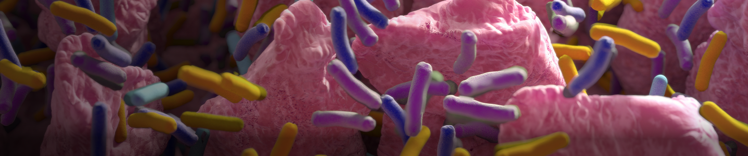
腸絨毛と細菌


プロバイオティクスとシンバイオティクスの有効性確保
プロバイオティクスの作用機序は、複雑かつ多様であり、また菌株に固有のものです。1,2 同じプロバイオティクス菌株でも、異なる作用機序により、異なる病原体を抑制する場合があります。3
さらに、同じ種でも系統が異なれば、効果も大きく異なります。2 複合プロバイオティクス(複数菌株で構成されている)は、単一菌株のプロバイオティクスよりも必ずしも効果が高いとは限りません。3,4 また、プロバイオティクスは投与量(用量)に依存するため、特定の菌株について効能を得るのに必要な適正量を確立するには、臨床研究が必要です。
ペットに使用可能なプロバイオティクスは数多く存在しますが、効能が証明されているものはほとんどありません。
加えて、ヒト用やペット用として市販されているプロバイオティクスの品質や純度については、多くの研究により疑問が提起されています。1,5-9 評価の対象となったヒト用および動物用プロバイオティクスで製品ラベルの内容を正確に反映していたのは、13 品目中 2 品目6、25 品目中 4 品目8 のみでした。また、別の所見では、生菌の濃度が低い、ラベルに記載された 1 つ以上の菌が含まれていない、菌が混入している、内容物の表示が不正確であることなども明らかになりました。6-9
プロバイオティクス(生菌)が一般的な製造、出荷、保管の条件に耐えうることを証明するには、効果的なプロバイオティクスの基準をすべて満たすことに加えて、安定性試験を実施する必要があります。Purina は、この分野の研究を幅広く行うことにより、有効性、安定性、安全性に優れたプロバイオティクスの開発を進めています。


プロバイオティクスに関する調査が拡大し、知識が増えるにつれ、ある種のプロバイオティクスについては、上記の基準をすべて満たしていなくても、消化器系以外の特定の健康効果(不安行動の軽減、肥満者の代謝反応の改善など)をもたらす可能性があることがわかってきました。
微生物叢フォーラムの他の領域を見る


詳しく知る
- Cunningham, M., Azcarate-Peril, M. A., Barnard, A., Benoit, V., Grimaldi, R., Guyonnet, D.,…Gibson, G. R. (2021). Shaping the future of probiotics and prebiotics. Trends in Microbiology, 29(8), 667—685. doi:10.1016/j.tim.2021.01.003
- Barros, C. P., Guimarães, J. T., Esmerino, E. A., Duarte, M. C. K. H., Silva, M. C., Silva, R.,…Cruz, A. G. (2020). Paraprobiotics and postbiotics: concepts and potential applications in dairy products. Current Opinion in Food Science, 32, 1–8. doi:10.1016/j.cofs.2019.12.003
- Kekkonen R. A.,Kajasto, E., Miettinen, M., Veckman, V., Korpela, R., & Julkunen, I. (2008). Probiotic Leuconostoc mesenteroides ssp. cremoris and Streptococcus thermophilus induce IL12 and IFN-γ production. World Journal of Gastroenterology, 14, 1192–1203.
- Viljanen, M., Kuitunen, M., Haahtela, T., Juntunen-Backman, K., Korpela, R., & Savilhati, E. (2005). Probiotic effects on faecal inflammatory markers and on faecal IgA in food allergic atopic eczema/dermatitis syndrome infants.Pediatric Allergy and Immunology, 16, 65–71.
- Rolfe, R.D. (2000).The role of probiotic cultures in the control of gastrointestinal health. Proceedings of the Probiotic Bacteria: Implications of Human Health Symposium. Journal of Nutrition, 130, 396S–402S.
- Weese, J. S. (2002). Microbiologic evaluation of commercial probiotics. Journal of the American Veterinary Medical Association, 220, 794–797.
- Weese, J. S., & Arroyo, L. (2003). Bacteriological evaluation of dog and cat diets that claim to contain probiotics. Canadian Veterinary Journal, 44, 212–215.
- Weese, J. S. (2003). Evaluation of deficiencies in labeling of commercial probiotics. Canadian Veterinary Journal, 44, 982–983.
- Weese, J. S., & Martin, H. (2011). Assessment of commercial probiotic bacterial contents and label accuracy. Canadian Veterinary Journal, 52,43–46.