Test Article Cards
Some body text

Brain & Cognitive Disorders
Tips for a Pet-Friendly Relocation
Whether a new home is across town or across the country, relocating is often stressful for pets. Their current home is more than their home; it is their territory. Cats, especially, are very sensitive and prefer to be in a familiar environment. Dogs tend to adjust more easily than cats. However, moving to a new home can be an anxious time for dogs as well. If the time comes for you to relocate to a new home, there are ways you can help to reduce your pet’s stress and anxiety.

Test Manual Cards
Some body text


HighLights QA test
HighLights QA testHighLights QA testHighLights QA testHighLights QA testHighLights QA testHighLights QA test
HighLights QA test
HighLights QA testHighLights QA testHighLights QA testHighLights QA testHighLights QA test
Changing Diets
Switching Pet Foods - Dogs
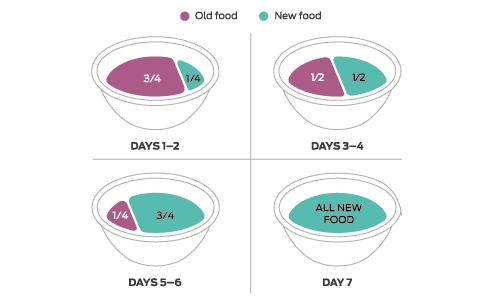
Gradually transitioning onto a new diet will minimize the risk of stomach upset or other issues. In order not to overfeed – check the feeding guidelines on the new food and the recommended amount for the dog’s weight (assuming the pet has a good body condition score).
Gradually replace ¼ of the current food with the ¼ of the new food every 2nd day. After 7 days, the switch over to the new food is complete.
If a pet is susceptible to stomach upset, it may be beneficial to transition over 10 days.
What Do Cats Need to Thrive?
Giving cats what they need for a long, healthy life starts with nutrition. But if you want your cat to thrive, you will want to provide more than just food and water. As long-time feline fanciers know, many cats are quite social and enjoy daily attention from their owners, no matter how self-reliant they may seem.
Here’s an overview of the essentials — with an emphasis on nutrition — so you can help your cat thrive.
Test Brand Grid
Some body text
- Bitches should be in ideal body condition prior to breeding for optimal fertility, appropriate puppy birth weight and reduced pup mortality.
- Switching to a food designed for growth and reproduction (e.g., a puppy formula) either just before breeding or during the first 6 weeks of pregnancy can help bitches become accustomed to a more energy- and nutrient-dense diet for later in gestation and lactation. When switching foods, gradually introduce the new diet over 7 days to minimize digestive upsets.
- Try to avoid switching diets at about 3 to 4 weeks of gestation, as many bitches experience a form of “morning sickness” and may reduce their food intake. Switching diets at this time may result in rejection of the new food.
- It is very important to monitor food consumption to avoid excessive calorie intake during early gestation.
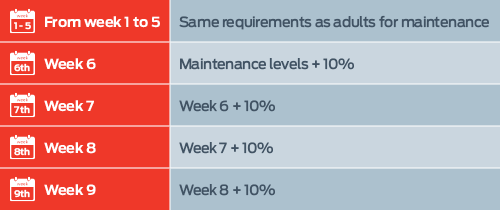
- Increased food intake is necessary from the sixth week of a dog’s 9-week gestation.
- During the first two trimesters of pregnancy, a pregnant bitch’s energy needs are like her adult maintenance requirements.
- Unless a dog is underweight at breeding, increasing the amount of food prior to the fifth week of gestation is not recommended.
Energy Needs of the Pregnant Dog During Gestation
- In the last 3 to 4 weeks of gestation, a bitch’s requirements for energy and other nutrients increase.
- Developing puppies grow rapidly during the last 3 to 4 weeks of pregnancy.
- Energy requirements of the bitch increase from 25% to 50%, depending on litter size.
- Dietary DHA (docosahexaenoic acid), an omega-3 fatty acid, helps ensure optimal neural and vision development in puppies both in utero and postpartum.
- Feeding a high-quality, nutritionally complete and balanced puppy formula will supply all the necessary nutrients with no supplementation required.
- Feeding several meals daily or free choice during the last 3 to 4 weeks of gestation will help ensure a bitch is receiving enough nutrition despite increasingly limited abdominal space for food and digestion.
- Lactation is considered the most nutritionally demanding life stage, with nutrient requirements higher than for growth.
Energy Requirements of the Lactating Dog

- Lactating dogs require a highly digestible, energy- and nutrient-rich diet (e.g., puppy formula) to meet the demands of milk production and to maintain their own body condition.
- Milk production peaks about 3 to 4 weeks after whelping.
- Energy requirements increase steadily, peaking at two to four times prebreeding maintenance levels.
- Feeding several times per day or free choice during the first 3 to 4 weeks after whelping helps meet the higher energy demands of lactation.
- Milk production will begin to decline as puppies start eating solid food.
- Limited feeding of the bitch for 1 to 2 days before weaning can help decrease milk production.
- On the day before weaning, the dam should be separated from the puppies. While all food should be withheld from her to help slow milk production, continue to provide fresh water.
- The dam and puppies can be reunited that evening after the puppies have eaten. Continue the fast overnight to further reduce the bitch’s milk production and to encourage the puppies to eat solid food in the morning.
- On weaning day, permanently separate the bitch from the puppies.
- Feed the bitch about 25% of the amount and type of food fed prior to breeding.
- Over the next 3 days, gradually increase the amount of food fed so that the bitch is receiving 100% of her prebreeding maintenance level.
Prebreeding, estrus and mating
- Bitches should be in ideal body condition prior to breeding for optimal fertility, appropriate puppy birth weight and reduced pup mortality.
- Switching to a food designed for growth and reproduction (e.g., a puppy formula) either just before breeding or during the first 6 weeks of pregnancy can help bitches become accustomed to a more energy- and nutrient-dense diet for later in gestation and lactation. When switching foods, gradually introduce the new diet over 7 days to minimize digestive upsets.
- Try to avoid switching diets at about 3 to 4 weeks of gestation, as many bitches experience a form of “morning sickness” and may reduce their food intake. Switching diets at this time may result in rejection of the new food.
- It is very important to monitor food consumption to avoid excessive calorie intake during early gestation.
Gestation
- Increased food intake is necessary from the sixth week of a dog’s 9-week gestation.
- During the first two trimesters of pregnancy, a pregnant bitch’s energy needs are like her adult maintenance requirements.
- Unless a dog is underweight at breeding, increasing the amount of food prior to the fifth week of gestation is not recommended.
Energy Needs of the Pregnant Dog During Gestation
- In the last 3 to 4 weeks of gestation, a bitch’s requirements for energy and other nutrients increase.
- Developing puppies grow rapidly during the last 3 to 4 weeks of pregnancy.
- Energy requirements of the bitch increase from 25% to 50%, depending on litter size.
- Dietary DHA (docosahexaenoic acid), an omega-3 fatty acid, helps ensure optimal neural and vision development in puppies both in utero and postpartum.
- Feeding a high-quality, nutritionally complete and balanced puppy formula will supply all the necessary nutrients with no supplementation required.
- Feeding several meals daily or free choice during the last 3 to 4 weeks of gestation will help ensure a bitch is receiving enough nutrition despite increasingly limited abdominal space for food and digestion.
Lactation
- Lactation is considered the most nutritionally demanding life stage, with nutrient requirements higher than for growth.
Energy Requirements of the Lactating Dog
- Lactating dogs require a highly digestible, energy- and nutrient-rich diet (e.g., puppy formula) to meet the demands of milk production and to maintain their own body condition.
- Milk production peaks about 3 to 4 weeks after whelping.
- Energy requirements increase steadily, peaking at two to four times prebreeding maintenance levels.
- Feeding several times per day or free choice during the first 3 to 4 weeks after whelping helps meet the higher energy demands of lactation.
- Milk production will begin to decline as puppies start eating solid food.
Weaning and post-weaning
- Limited feeding of the bitch for 1 to 2 days before weaning can help decrease milk production.
- On the day before weaning, the dam should be separated from the puppies. While all food should be withheld from her to help slow milk production, continue to provide fresh water.
- The dam and puppies can be reunited that evening after the puppies have eaten. Continue the fast overnight to further reduce the bitch’s milk production and to encourage the puppies to eat solid food in the morning.
- On weaning day, permanently separate the bitch from the puppies.
- Feed the bitch about 25% of the amount and type of food fed prior to breeding.
- Over the next 3 days, gradually increase the amount of food fed so that the bitch is receiving 100% of her prebreeding maintenance level.
- Microbiome Forum Round Table 2025: 20 February
- Purina Institute Global Summit 2025: 30 Apr-1 May
- Purina Institute Microbiome Forum Virtual Event 2025: 12-13 November
- Feeding Dogs with Osteoarthritis: Prevention through Rehabilitation: 13 March
- Nutritional Management of Canine Epilepsy: 19 June
- Nutrition and the Hospitalized Pet: 10 July
- Feeding and Avoiding Food Aversions in the Finicky Feline: 21 August
- Antibiotic Stewardship for Gastrointestinal Disease: 22 October
- Nutritional Approaches to Lower Urinary Disease in Cats: 27 November
- Don't Forget the Diet: Incorporating Diet into Daily Dermatology Case Management: 15 May
- Comprehensive Management of Feline CKD: Part Two: 17 July
- Implementing a Successful Weight Loss Program: 11 September
- Nourishing Bonds: How to Prevent and Address Food Aversions in Pets: 4 December
Related Tools and Content:
Feeding the Brain: Putting Purina’s Nutritional Science Into Practice
The developing brain has unique nutritional demands to set the foundation for lifelong brain health. Metabolic changes and risk factors associated with brain aging, age-related cognitive decline, and the resulting behavioral changes can be targeted with nutritional interventions that support healthier brain aging.
The Aging Brain
Similar to humans, aging in pets results in numerous metabolic, functional and physical changes in the brain.
Proactive Approach to Diagnosing and Managing Canine CDS: A Panel Discussion
Read how to improve diagnosis of canine cognitive dysfunction syndrome and about its comprehensive management, including nutritional intervention, in this discussion featuring veterinary neurologist and neurosurgeon Dr. Tom Cardy and veterinary behaviorist Dr. Margaret Gruen. Also features remarks about cats and cognitive function.
BEYOND NUTRITION: PARTNERING WITH PET OWNERS
Speaker:
Jennifer Reinhart, DVM, PhD, DACVIM (SAIM), DACVCP
Event date: 6–7 November 2024 Virtual Event
Veterinarians generally accept that many drugs affect the gut microbiome. But what about the reverse: How does the intestinal microbiome impact the pharmacokinetics and pharmacodynamics of administered drugs?
The relationships between drug, microbiome, and host/patient are complex. Dr. Jennifer Reinhart introduces veterinary professionals to pharmacomicrobiomics, an emerging and important component of personalized medicine. Researchers now recognize the gut microbiota, with its large metabolic capacity, contributes to interindividual variation in host/patient response to drugs.